I create my goals for weight loss and bodyfat percentage based on where I am when I start, what a reasonable weight loss amount is per week, and what a reasonable assumption for fraction of that being fat is. I think that’s a decent system, and when I stick with things, the estimates/goals/forecasting tends to be decent. With some very occasional adjust-as-you-go.
The way I currently calculate bodyfat is by taking several different circumferential measurements of things like my neck, forearms, wrists, waist, and hips (I take other measurements but those don’t factor in), and I use three different bodyfat percentage formulas that I found online over the years. I don’t use the scales with the metal plates because – at least when I was looking at them way back when – they weren’t that accurate though you could usually trust a pattern (e.g., you’re going up or down). In fact, a quick internet search shows that’s still the case (such as this article).
Where am I going with this? Based on my three different formulas, my bodyfat percentage last week was either 24.4%, 28.6%, or 30.3%. That is a huge range. So what I actually do is take the average and standard deviation of those, so I said I was 27.8±3.0%. This is also why I’ll be celebrating when I hit about 23.0% bodyfat because then I will be well outside the average ± standard deviation from my initial measurement this go-’round and it should be obvious that I’m losing fat.
Okay, but where am I really going with this? I’ve forecast down to where I hope to be next ≈April, which would be the end of this “first” cut phase to lose weight and get down to 170 lbs and be at 12.5% bodyfat. The problem is, to get there, I have to lose a bit of muscle from my forearms (I suppose it could be some fat padding?), barely lose anything from my hips, lose some substantial waist inch-age, and my three formulas still give 12.0%, 12.5%, and 13.4%, for 12.6±0.7%.
Okay, that’s not a crazy amount of spread. However, my lows back in July 2008 and November 2011 had spreads of just ±0.4% and ±0.5%.
If I instead had that bodyfat percentage goal but weighed 10 lbs more, we get to a spread of only ±0.3%
What’s the point of going through that exercise? Well, one is fingers-crossed I get there so that I actually have to worry about whether my goal is 180 lbs or 170 lbs. But two is that these formulas are all based on measuring a gagillion peoples’ bodies, measuring their actual bodyfat percentage much more accurately than using these circumference measurements, and then effectively doing a best-fit to figure out how to go from the circumference measurements to the bodyfat percentage so you have a less invasive, more practical and easy way to get at bodyfat. And because it’s a best-fit, there will always be outliers ’cause no two people are the same.
Clearly, right now, my body proportions do not fit into these formulas very well given the huge spread I’m getting. I guess I carry my fat differently, or when they were designing these, they didn’t measure enough people of my girth. Hopefully, when I get leaner, they will.
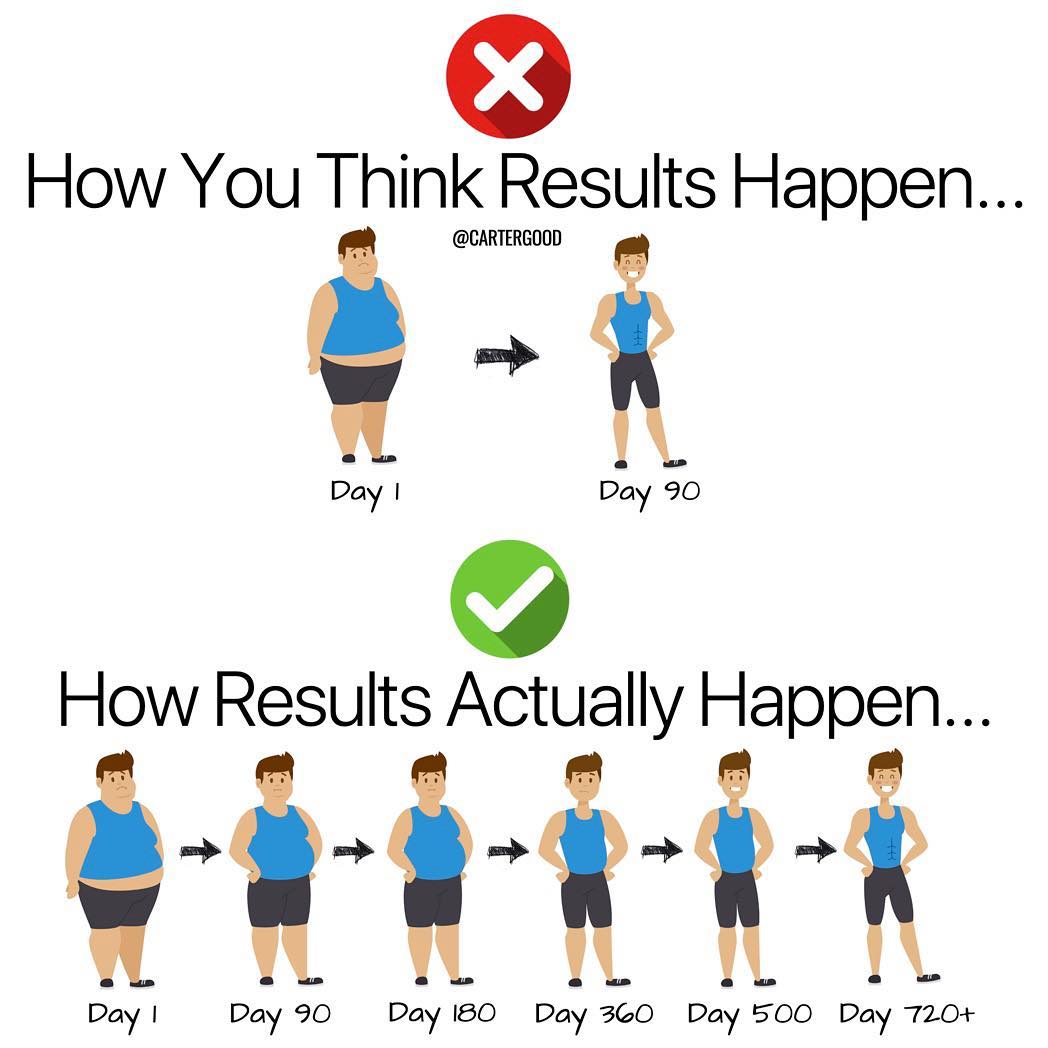
But the point of this post – or, the point when I started out – was to muse more about how making these sorts of projections for where I hope to be literally 44 weeks after I start is going to be fraught with uncertainty. And, I’m going to have to re-calibrate and adjust. And, I’m going to (hopefully!) get to a point where I’m happy with how I look and can base weight and bodyfat less on the numbers and more with what it looks like on me.
And, because we all know that I’m too OCD for that last sentence, there are always the other, more raw numbers: Is my waist still in a small range that I want? Are my biceps and chest larger, but firm (not fat)? Are abs visible? Etc. Right now, getting to that point is still theoretical, for I have never been there, but I really want to be.

 My Fitness Blog